Breathwork Retreat vs Yoga Retreat: What Actually Reaches Deeper
You have probably done a yoga retreat before. You came back feeling better than when you left. Then two or three weeks passed and you were back to where you started.
This is not a yoga problem. Yoga retreats do what they do well. The issue is that physical movement, even beautiful, well taught physical movement, does not always touch the patterns that run underneath. The tension that grips your chest when a stressful email arrives. The tightness in your throat before a hard conversation. The way your mind runs at 2am when your body is exhausted and your brain will not stop.
Those patterns live in your autonomic nervous system, not your muscles.
If you are choosing between a yoga retreat and a breathwork retreat, here is what actually differs. Not in theory. In your body.
What Is the Difference Between a Breathwork Retreat and a Yoga Retreat?
A yoga retreat uses physical postures to shift your nervous system indirectly, over time. A breathwork retreat changes your breathing pattern, which shifts the nervous system directly and immediately, because the breath is the one autonomic function you can consciously control. Yoga works the body toward the nervous system; breathwork reaches the autonomic level that yoga points toward.
Yoga Works the Body Toward the Nervous System. Breathwork Works the Nervous System Directly.
Yoga uses physical postures and movement to create conditions where your nervous system can shift. It works. Through consistent practice, your body softens, your breathing deepens, and your parasympathetic system gets more room. But it is an indirect route. You move the body, and the nervous system responds over time.
Breathwork reverses the order. You change your breathing pattern, and your nervous system shifts immediately because the breath is the only autonomic function you can consciously control. Heart rate, blood pressure, digestion, immune response: all of these run on autopilot. Your breath is the one input you can change directly, and it communicates with everything else through the vagus nerve.
When you extend your exhale beyond your inhale for even a few minutes, your heart rate drops, cortisol production slows, and your prefrontal cortex comes back online. When you breathe in a continuous connected pattern for 30 to 40 minutes, your blood chemistry changes. Carbon dioxide drops. Brain waves shift from beta (alert, scanning) into alpha and theta (open, receptive). Your body enters a state where stored tension can surface and complete itself.
A yoga class might take 90 minutes of sustained practice to produce a fraction of the nervous system shift that 20 minutes of guided breathwork produces. This is not a value judgment. It is a difference in mechanism. If the goal is nervous system regulation rather than physical conditioning, the direct route is faster. The nervous system reset article covers the physiology in detail.
No Physical Barrier to Entry
Yoga retreats have a barrier that nobody talks about directly. If you cannot hold a plank, flow through sun salutations, or keep pace with the group, a yoga retreat can feel like a performance rather than a recovery. You spend the week watching other people be more flexible and wondering if you are doing it wrong.
Breathwork removes this entirely.
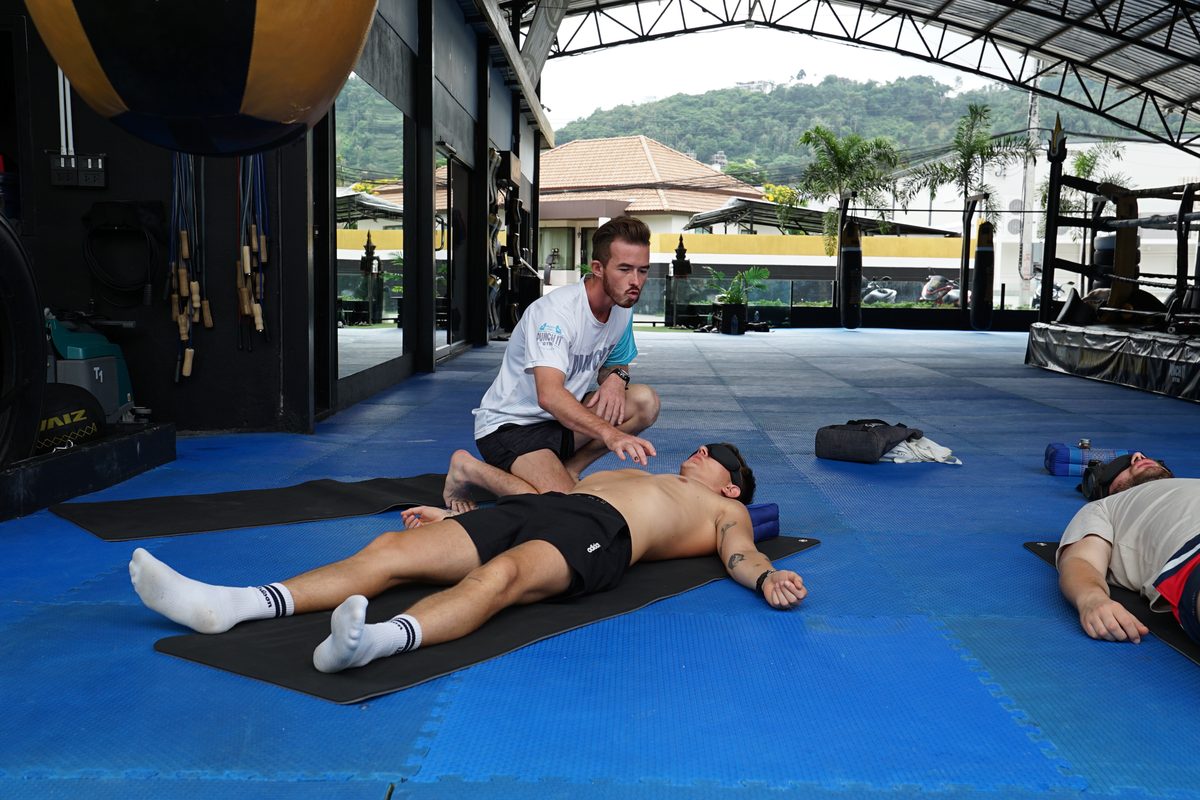
You lie down. You breathe. The depth of your experience has nothing to do with your fitness, flexibility, or prior experience. I have facilitated sessions with professional athletes and people who have not moved their bodies intentionally in years. The breath goes equally deep because what you are working with is physiology, not performance.
The only requirement is willingness. Willingness to breathe continuously for 30 minutes and see what happens. That is accessible to virtually every human body. The beginners guide covers exactly what to expect with no experience.
Which Reaches Deeper, Breathwork or Yoga?
Breathwork reaches deeper, faster, when the goal is shifting nervous system patterns rather than building flexibility. Yoga works voluntary muscles and conscious movement; the stress responses and stored tension you most want to release sit below voluntary control. The breath bridges the voluntary and involuntary, so it accesses the autonomic territory that asana alone rarely crosses.
This is the observation that comes up most consistently. People who have practiced yoga for years often describe their first breathwork session as reaching something they had been circling for a long time but could not quite get to.
Yoga builds body awareness and breath awareness. It teaches you to notice sensation and stay present with discomfort. These are genuinely valuable skills, and they are exactly the foundations that allow breathwork to go deeper. Yoga prepares you for what breathwork accesses. The problem is that asana alone rarely crosses the threshold into autonomic nervous system territory.
Here is why. Yoga postures work with voluntary muscles and conscious movement. Your autonomic nervous system, the system that drives stress responses, emotional reactivity, sleep quality, and the deep patterns that run underneath your daily experience, operates below voluntary control. You cannot downward dog your way into a vagal state shift.
But you can breathe your way there. Because the breath sits at the intersection of voluntary and involuntary. It is the bridge.
When the breathing pattern is sustained for 30 to 40 minutes, people begin releasing stored tension in ways that movement alone does not access. Shaking. Tears. Sounds. Laughter. These are not performances. They are the nervous system completing cycles that have been frozen, sometimes for years. The somatic breathwork article explains exactly why this happens physiologically.
I came to breathwork through freediving, not yoga. Ten years of underwater breath control taught me something about how the breath interacts with the body that is different from the yogic lens. Freediving is about precision: exact lung volumes, exact CO2 tolerance, exact management of the dive reflex. That precision translates into facilitation in ways that a purely yogic background does not provide. The freediving and breathwork article explains how those disciplines connect.
This is also why the two pair so well rather than compete. The yoga practitioners who come to my sessions arrive with something most beginners do not have: they already know how to stay with sensation instead of bolting from it. They can feel the difference between effort and strain. They notice their breath without me telling them to. That groundwork means they often drop into the deep part of a breathwork session faster than someone who has never trained their attention on the body at all. Years of asana built the doorway. Breathwork is what walks them through it.
What years of facilitating both has shown me is that the question is rarely which one is better. It is which one your nervous system needs more of right now. If you live disconnected from your body and need to rebuild the basic skill of feeling, start with movement. If you can already feel your body but cannot get the deeper patterns to shift no matter how much you practise, that is the signal that you have hit the ceiling of what asana reaches, and breathwork is the next step. You can map where you currently sit using the Internal Terrain framework.
Cold Exposure Adds a Dimension Yoga Does Not
Every breathwork session I facilitate includes an ice bath. This is not an add on. It is an integrated part of the experience.
After 30 to 40 minutes of conscious connected breathing, your nervous system reaches a specific state: open, processed, regulated. Getting into ice water at this point produces a response that is qualitatively different from cold exposure done alone. The breathwork has primed your system. You have just spent 40 minutes practicing the skill of staying present with intensity without fighting it. The ice bath is where you apply that skill to a physical challenge.
The combination creates something neither practice delivers separately. Breathwork opens the nervous system. Cold exposure tests and trains it. The thermal contrast in a tropical setting like Koh Samui amplifies the effect because the gap between warm air and cold water is extreme. Research shows norepinephrine increases of 200 to 300 percent following cold water immersion at temperatures below 10 degrees. That neurochemical shift affects mood, focus, and stress resilience for hours afterward.
Yoga retreats typically do not include cold exposure. That is a different focus. But if you want both the opening and the reset, breathwork plus ice bath is the sequence that delivers it. The cold exposure science article explains what is happening in the body.
The Shifts Are Measurable and They Compound
On a yoga retreat, you typically feel good by day three or four as your body adjusts. The peak comes near the end. Then you fly home and the familiar patterns reassert themselves within weeks.
Breathwork operates differently because the intervention is at the autonomic level, not the muscular level.
After a single guided breathwork session, your nervous system has a new reference point. It has experienced what regulation actually feels like. That reference does not vanish when you leave the island. Your heart rate variability, the measure of how efficiently your system shifts between activation and recovery, can improve measurably after one intensive session. Over multiple sessions, those improvements compound.
I hear this regularly: the shifts from a single day of breathwork and cold exposure stayed in ways that a week of yoga did not. Not because yoga failed. Because yoga was working a different system.
This does not mean yoga is less valuable. A consistent yoga practice over months builds something that a single breathwork session cannot match. But if you have limited time, want maximum impact from a retreat experience, and are trying to shift deep patterns rather than improve flexibility, breathwork delivers more change per hour than anything else I have found.
The Honest Version
A yoga retreat is not the wrong choice. If movement, community, and the discipline of daily practice are what you need, go. It is a good thing.
But if you are carrying accumulated tension from months or years of running at a pace that leaves no room for real recovery, breathwork gets there faster. The nervous system responds to the direct intervention. You feel it the same day. And because the shift happens at the autonomic level, not the muscular level, it tends to hold.
If you want to experience the full combination, UNTAMED is a full day on Koh Samui: breathwork, ice bath, jungle, honest conversation, time to integrate. No experience required.
If you are a yoga retreat leader and want to add this to your program, the retreat leader guide covers logistics, format, and how it integrates with existing yoga programming. Many yoga retreat leaders bring me in for exactly this reason: it reaches where their asana curriculum does not.
For groups, private workshops run two hours at your venue. 4 to 16 people. All equipment included. If you would rather build a regular practice than do a single retreat day, the weekly group sessions on Koh Samui are open to every level.
Keep Reading
Frequently asked questions
What is the difference between a breathwork retreat and a yoga retreat?
A yoga retreat uses physical postures to shift your nervous system indirectly, over time. A breathwork retreat changes your breathing pattern, which shifts the nervous system directly and immediately, because the breath is the one autonomic function you can consciously control. Yoga works the body toward the nervous system. Breathwork reaches the autonomic level that yoga points toward.
Which one reaches deeper, breathwork or yoga?
Breathwork reaches deeper, faster, when the goal is shifting nervous system patterns rather than building flexibility. Yoga works voluntary muscles and conscious movement, but the stress responses and stored tension you most want to release sit below voluntary control. The breath bridges the voluntary and involuntary, so it accesses the autonomic territory that postures alone rarely cross.
Do I need to be fit or flexible to do a breathwork retreat?
No. You lie down and you breathe. The depth of your experience has nothing to do with your fitness, flexibility, or prior experience. I have facilitated sessions with professional athletes and people who have not moved their bodies intentionally in years, and the breath goes equally deep because you are working with physiology, not performance. The only requirement is willingness.
I already practise yoga. Is breathwork still worth it?
Yes, and your yoga makes it richer. Yoga practitioners arrive already knowing how to stay with sensation instead of bolting from it. That groundwork means they often drop into the deep part of a breathwork session faster than someone who has never trained their attention on the body. Years of postures built the doorway. Breathwork is what walks you through it.
Why do your sessions include an ice bath?
Every session I facilitate includes an ice bath as an integrated part, not an add on. After 30 to 40 minutes of conscious connected breathing, your nervous system is open and regulated. Getting into ice water at that point produces something cold exposure alone does not. Breathwork opens the nervous system. Cold exposure tests and trains it. Yoga retreats typically do not include this.
Stay in the loop.
Occasional dispatches when sessions open or new writing drops. No spam.
About Diego Pauel
I have lived in Koh Samui for 15 years. I discovered breathwork through freediving, which I have trained in for over a decade. When COVID hit and the island emptied out, I started offering breathwork and ice baths for free to help the local community feel better in their bodies. I was the first to offer this work on the island. Five years later, I have facilitated countless sessions for people from all over the world. No guru energy. No mystical language. Just the work.
Full story →Want to experience the work?
See the ProgramsContinue Reading
All Breathwork →