Why Koh Samui for Breathwork Facilitator Training (What the Island Gives You That a Studio Never Will)
You have decided to train as a breathwork facilitator. You have researched programs, compared curricula, and read about different certification paths. But here is a question that most people skip too quickly: where should you train?
Where you train as a breathwork facilitator shapes how deeply you absorb the work, because your environment directly affects your nervous system and your capacity to learn. Koh Samui offers tropical heat that opens the body, nature woven into the curriculum, and a slow pace with no commute or inbox pulling you out of the experience.
The location of your training is not a cosmetic detail. It is not about having nice photos for your social media. The environment you train in shapes how deeply you absorb the work, how fully you can immerse yourself, and how well you integrate what you learn. After facilitating breathwork on Koh Samui for over five years and training facilitators here, I can tell you that this island gives people something that no studio, conference room, or online platform ever will.
Your Training Environment Is Not Neutral
Think about the last time you tried to learn something important in a stressful environment. Maybe a classroom with fluorescent lights and street noise outside. Maybe an online course you squeezed between meetings. The content might have been excellent. But your nervous system was somewhere else. Partially activated. Partially distracted. Learning at maybe sixty percent capacity.
Now imagine the opposite. You wake up with no commute. No meetings. No inbox pulling at you. You walk to a training space surrounded by tropical plants with warm air on your skin and the sound of birds. Your nervous system has already started to downregulate before the first session begins. You are present. You are open. And everything you learn lands deeper because your body is in a state that allows it.
This is not about luxury. It is neuroscience. Your environment directly affects your autonomic nervous system, which directly affects your capacity to learn, integrate, and retain what you are experiencing. If you want to understand where your own nervous system sits right now, the two minute terrain assessment gives you a clear picture. A breathwork facilitator training is not an academic subject you can cram from a textbook. It requires your whole body to participate. And your whole body responds to where it is.
The Heat
Koh Samui sits close to the equator. Average temperatures hover around 28 to 34 degrees Celsius year round. For breathwork training, this matters more than people expect.
Warm temperatures relax your musculature before you even begin a session. Your diaphragm moves more freely. Your chest and rib cage soften. Breathing deepens naturally without you trying. This means every practice session during your training starts from a more open baseline than if you were training in a cold climate where your body is contracted just from the temperature.
The heat also amplifies cold exposure work. When you step into an ice bath after hours in tropical warmth, the contrast is extreme. Your nervous system gets a much larger signal than it would in a temperate climate where the gap between air temperature and ice water is smaller. For facilitator training, this matters because you need to understand cold exposure deeply in your own body before you can guide others through it. Training in a tropical environment gives you that depth of experience.
Nature as Part of the Curriculum
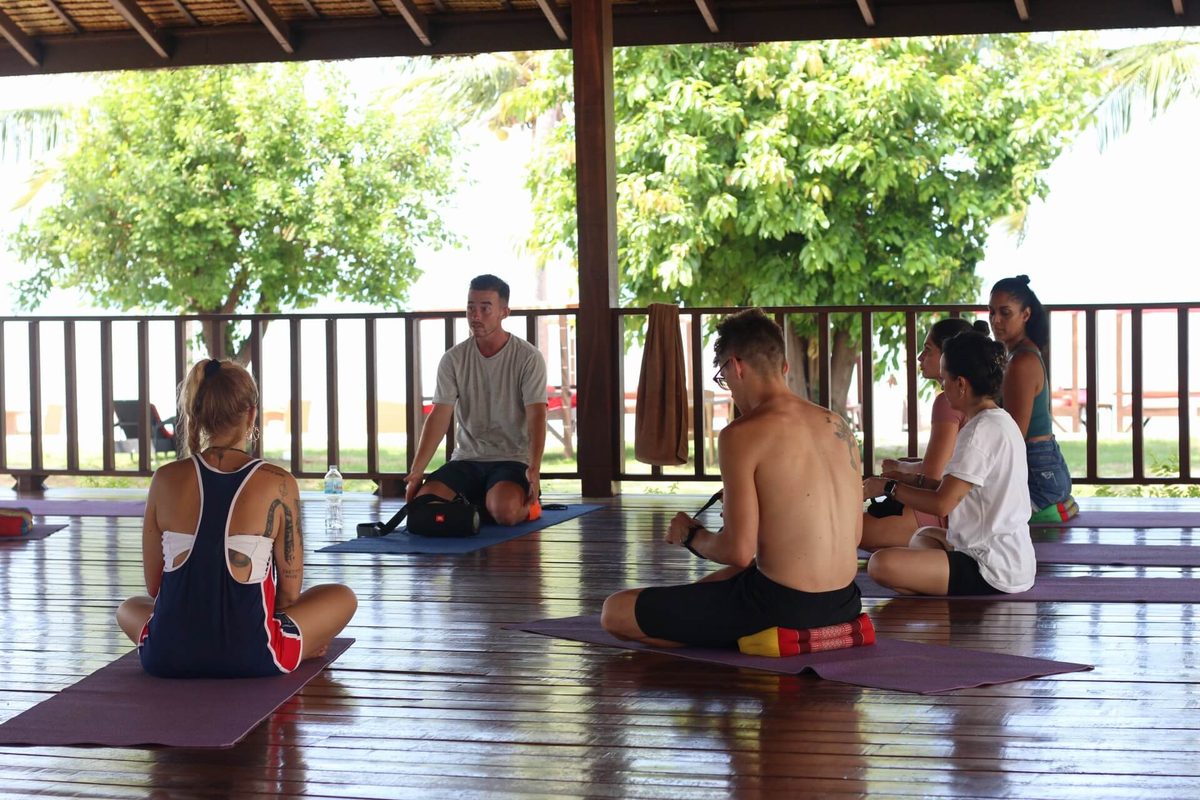
Most of what we do happens outdoors. Morning breathwork near the ocean. Practice facilitation under a shala with jungle sounds instead of traffic. Movement sessions on grass rather than on a gym floor. Cold exposure with the beach visible from where you stand.
Nature is not a backdrop for the training. It is part of the training. Your nervous system reads its environment constantly through a process called neuroception. Natural environments with green space, moving water, natural light, and open air signal safety to your body at a level below conscious awareness. That safety is the prerequisite for going deep in breathwork. And for facilitator trainees, experiencing that depth repeatedly in a natural setting teaches you something about environment design that no slide deck ever could.
When you go home and set up your own practice, you will intuitively understand how much the space matters. Not because someone told you. Because you felt it for 21 days straight.
The Cost Reality
Breathwork facilitator trainings in Europe run between $4,000 and $7,000 before you factor in accommodation and food. A comparable program in Bali or Costa Rica is typically $3,000 to $5,000. The Breathflow Connection course is $2,490 with breakfast and lunch included daily.
But the savings go beyond the program fee. Accommodation in Koh Samui ranges from $15 to $50 per night depending on your preferences. A solid meal costs $3 to $8. Transportation is affordable. This means your total investment for a 21 day training including accommodation, food outside of the included meals, and basic living expenses comes in significantly under what a European or North American program costs for tuition alone.
This is not about being cheap. It is about being smart. If budget is a factor in your training decision (and for most people it is), Thailand allows you to invest in a thorough, extended training without the financial strain that a European equivalent might create. Less financial stress means more mental space for the actual learning.
The Pace of Island Life
Koh Samui is not Bangkok. It is not Bali with its traffic and constant stimulation. It is a relatively quiet island where the pace of life matches what a training period requires. Slow enough to process. Calm enough to integrate. Spacious enough to let things settle.
During a 21 day facilitator training, you are going through a significant personal process alongside the professional learning. Old patterns surface. Emotions move. Your relationship with your own breathing changes. You need time and space for all of that to happen without being rushed back into stimulation every evening.
On Koh Samui, your evenings might include a walk on the beach, a quiet meal, journaling, or an early night. There is no nightclub district pulling at you. No tourism chaos. No pressure to be anywhere or do anything. The island holds the container that the training needs.
Cold Exposure in the Tropics
Ice bath work is integrated into every offering at Breathflow Connection. During the facilitator course, you do not just learn about cold exposure as a concept. You practice it repeatedly. You learn to guide others through it. You understand the physiology from the inside.
Training with cold exposure in a tropical environment has a specific advantage. The thermal contrast between 33 degree air and 2 degree water is among the largest you will experience anywhere. That contrast creates a more pronounced autonomic response, which means your training sessions give you a wider range of experience to draw from when you start facilitating.
You also learn to work with heat as a variable. How does breathwork shift when people are already warm? How does cold exposure land differently when the body has been in tropical heat all day? These are practical questions that only arise when you train in this kind of climate. Facilitators who train in temperate environments miss this entirely.
Practical Logistics
Getting here. Koh Samui has its own international airport (USM) with direct flights from Bangkok, Singapore, Kuala Lumpur, and Hong Kong. You can also fly into Surat Thani and take a ferry, which is cheaper but adds a few hours. Most participants arrive the day before the course starts.
Visas. Thailand offers visa exempt entry for most nationalities (30 days) or a tourist visa (60 days). The 21 day course fits comfortably within that window for most passport holders. Check your specific country requirements before booking.
Accommodation. The course takes place in Koh Samui. Affordable guesthouses and apartments are available near the training venue. We can recommend options at different price points once you are accepted. Most participants spend $400 to $800 total on accommodation for the 21 days.
What to bring. Comfortable clothing you can move and breathe in. A water bottle. Sunscreen. An open mind. The training provides everything else you need for the sessions.
How It Compares
I will be honest about what other training destinations offer and where Koh Samui stands.
Bali. Beautiful island with an established wellness scene and many training options. Also crowded, touristy, and increasingly expensive. The constant stimulation of Ubud or Canggu can work against the immersive quality a facilitator training needs. If you want a broader wellness community around you, Bali has that. If you want focused immersion without distraction, Koh Samui is better suited.
Europe (Italy, Portugal, UK). High quality programs exist in Europe. The trade offs are price (typically 2x to 3x more expensive when you include accommodation and food), climate (training in cold or temperate weather changes the physical experience), and duration (many European programs run shorter to account for higher costs). If being close to home matters to you and budget is not a concern, European trainings can be excellent. If you want the fullest immersion for the best value, Southeast Asia wins.
Costa Rica. Similar tropical advantages to Thailand. Generally more expensive for accommodation and food. Fewer direct flight options from Asia and Europe. Strong retreat culture. A good option if you are based in the Americas.
Online. Online facilitator training exists. I do not recommend it for your foundational certification. You cannot learn to hold space through a screen. You cannot practice reading a room when the room is a grid of rectangles on a monitor. You cannot develop your physical presence and voice work through a laptop speaker. Online continuing education after your in person training is valuable. Online as your primary training is not sufficient for what this work demands.
What 21 Days on This Island Will Give You
Beyond the curriculum (which covers anatomy, breathing physiology, contraindications, session design, voice and presence, cold exposure facilitation, ethics, and business development), training on Koh Samui gives you something harder to quantify.
It gives you the lived experience of what it feels like to be fully immersed in the work. No commute. No split attention. Just breathwork, day after day, in an environment that supports every layer of the process. By day 21, the practices are not just in your head. They are in your body. Your voice has found its rhythm. Your presence has settled. You have facilitated real sessions for your cohort and received honest feedback. You have gone through your own process. And you have done all of this surrounded by nature, warmth, and a small group of people on the same path.
That foundation is worth more than any certificate.
New cohort dates are being confirmed. Maximum 16 participants per cohort. If you want to learn more or start a conversation about whether this is right for you, the full course details are here. You can also reach out on WhatsApp to talk directly. If you want to experience the work before committing to a training, UNTAMED is the full day breathwork and ice bath experience that gives you a taste of how we work.
Keep Reading
Frequently asked questions
Why does the location of breathwork facilitator training matter?
Because your environment directly affects your autonomic nervous system, which affects your capacity to learn, integrate and retain. Trying to absorb this work in a stressful classroom means your body is only at about sixty percent. On Koh Samui you wake with no commute, no inbox and no meetings, so your nervous system downregulates before the first session begins. Facilitator training is not an academic subject you cram from a textbook. Your whole body has to participate, and it responds to where it is.
How much does breathwork facilitator training in Koh Samui cost?
The Breathflow Connection course is 2,490 dollars with breakfast and lunch included daily. Beyond the program fee, accommodation in Koh Samui runs 15 to 50 dollars a night and a solid meal costs 3 to 8 dollars, so most participants spend 400 to 800 dollars on accommodation for the 21 days. European trainings typically run 4,000 to 7,000 dollars before accommodation and food. Less financial stress means more mental space for the actual learning.
How does Koh Samui compare to Bali for breathwork training?
Bali is a beautiful island with an established wellness scene and many options, but it is crowded, touristy and increasingly expensive. The constant stimulation of Ubud or Canggu can work against the immersive quality a facilitator training needs. If you want a broader wellness community around you, Bali has that. If you want focused immersion without distraction, and the best value, Koh Samui is better suited.
Why does the tropical climate help breathwork and cold exposure training?
Koh Samui sits near the equator at around 28 to 34 degrees Celsius year round. Warm temperatures relax your musculature, so your diaphragm and rib cage soften and breathing deepens naturally before you even begin. The heat also amplifies cold exposure work. When you step into an ice bath after hours in tropical warmth, the contrast between 33 degree air and 2 degree water is among the largest you will experience anywhere, which gives your nervous system a much bigger signal to train with.
Can I train to facilitate breathwork online instead?
Online training exists but I do not recommend it for your foundational certification. You cannot learn to hold space through a screen. You cannot practice reading a room when the room is a grid of rectangles on a monitor, and you cannot develop your physical presence and voice work through a laptop speaker. Online continuing education after your in person training is valuable. Online as your primary training is not sufficient for what this work demands.
Stay in the loop.
Occasional dispatches when sessions open or new writing drops. No spam.
About Diego Pauel
I have lived in Koh Samui for 15 years. I discovered breathwork through freediving, which I have trained in for over a decade. When COVID hit and the island emptied out, I started offering breathwork and ice baths for free to help the local community feel better in their bodies. I was the first to offer this work on the island. Five years later, I have facilitated countless sessions for people from all over the world. No guru energy. No mystical language. Just the work.
Full story →Want to experience the work?
See the ProgramsContinue Reading
All Koh Samui Wellness →