Breathwork for Anxiety: What Actually Helps (and What Does Not)
If you have ever Googled "breathing exercises for anxiety," you got a wall of generic advice. Breathe deeply. Count to four. Relax. As if the problem was that you forgot how to breathe and just needed a reminder.
Anxiety is a nervous-system state, not a mindset problem, so you cannot think your way out of it. Your breath is the brake because it is the one autonomic function you can consciously control. Slow breathing with long exhales engages that brake, but fast up-regulating patterns can make anxiety worse, which is why guidance matters.
Anxiety is not a breathing problem. But breathing is one of the fastest ways to change the physiological state that creates it. The catch is that not all breathing techniques help anxiety. Some of them make it significantly worse. And nobody seems to mention that part.
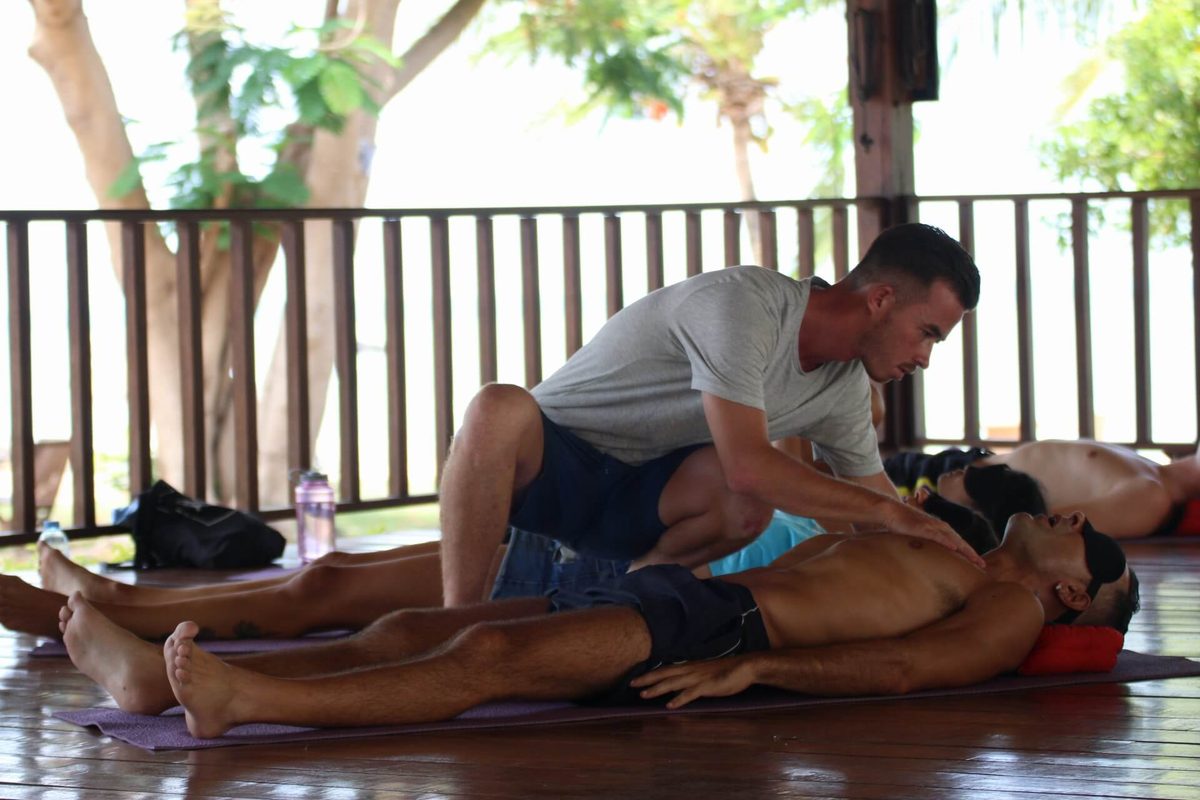
I have facilitated breathwork sessions for over five years in Koh Samui, Thailand. A large percentage of the people who come to me are dealing with some form of anxiety. Chronic tension. Racing thoughts. That tightness in the chest that shows up for no clear reason. Sleep that never fully restores them. I have seen what works in real time, in real bodies, with real people. And I have also seen well meaning breathwork make anxious people more anxious because nobody told them which patterns to avoid.
So here is the honest version.
Anxiety Is a Nervous System State, Not a Mindset Problem
This is the first thing that changes everything once you understand it.
Anxiety is not a thought. It is not a belief. It is not something you can logic your way out of. Anxiety is a physiological state. Your nervous system is stuck in threat detection mode. Your sympathetic branch, the fight or flight system, is running hot. Heart rate elevated. Muscles tense. Digestion disrupted. Cortisol circulating. Your body is bracing for a danger that is not actually there.
You know this already, even if you have never framed it this way. You have felt the tightness in your chest when nothing was wrong. You have felt your heart pounding before a conversation that was not actually dangerous. You have woken up at 3am with your mind racing about something you cannot control. That is not your mind being dramatic. That is your nervous system doing exactly what it was designed to do, except it is doing it at the wrong time, in the wrong context, and it does not know how to stop.
This is why positive thinking does not fix anxiety. You cannot think your way out of a body state. "Just relax" is the least helpful advice anyone has ever given an anxious person. It is like telling someone whose car is accelerating on its own to just want the car to slow down. The accelerator is stuck. You need to engage the brake.
Your breath is the brake. Not because of any mystical reason. Because the breath is the only autonomic function you can consciously control. Heart rate, digestion, blood pressure, you cannot change those directly. But you can change your breathing pattern. And when you change your breathing pattern, you change the signal your body sends to your brain about whether you are safe or in danger.
That is what breathwork actually does to your nervous system. Not by thinking different thoughts. By changing the physiological inputs your brain uses to determine your state. If you are not sure where your nervous system is right now, the two minute nervous system assessment can help you find out.
Breathing Patterns That Actually Reduce Anxiety
Not all breathing patterns are the same. Each one sends a different signal to your nervous system. For anxiety, you want patterns that activate the parasympathetic branch, the rest and recovery system, and specifically stimulate the vagus nerve.
Here are three that work reliably.
Extended Exhale Breathing
This is the single most effective breathing pattern for acute anxiety. If you take only one thing from this entire article, make it this.
- Inhale through your nose for 4 counts
- Exhale through your nose or mouth for 6 to 8 counts
- No pauses between breaths
- Continue for 3 to 5 minutes
Why it works: Your heart rate naturally speeds up slightly when you inhale and slows down when you exhale. This is called respiratory sinus arrhythmia, and it is completely normal. When your exhale is longer than your inhale, you spend more time in the phase where your heart rate is decelerating. This directly activates the vagus nerve and tells your parasympathetic system to engage.
Within two to three minutes of extended exhale breathing, most people notice a measurable drop in heart rate and a softening of the tension in their chest. It is not dramatic. It is not instant peace. But it is a real, physical shift that your anxious mind did not have to agree to. The body moved first and the mind followed.
Use this before sleep. Use it before a meeting that makes you nervous. Use it when the chest tightness shows up. Use it in your car before you walk into a situation you are dreading. Two minutes. That is all it takes to start the shift. You can practice this pattern right now using the free breath pacer.
Coherent Breathing
This is the most studied breathing pattern for sustained nervous system regulation. It is also the most boring, which is actually a feature.
- Inhale for 5 to 6 counts
- Exhale for 5 to 6 counts
- Equal inhale and exhale, no pauses
- Aim for about 5 to 6 breaths per minute
- Practice for 10 to 20 minutes
Coherent breathing brings your heart rate variability (HRV) into its optimal range. HRV is a measure of how flexibly your nervous system shifts between states. Higher HRV means your system can speed up when needed and slow down when needed. It is adaptive. Responsive. Resilient. Low HRV means you are stuck. Locked in one gear, usually the anxious one.
You will often see it claimed that regular coherent breathing raises heart rate variability over time and rewires your baseline. Treat that carefully. Breathing slowly mechanically widens the swing in heart rate whether or not anything lasting has changed, and one of the better controlled trials found no change in heart rate variability at all across four different breathing practices, even while people reported feeling better. What is genuinely supported is narrower: slow paced breathing lowers blood pressure a few points in people with raised blood pressure, and it makes most people feel calmer while they are doing it. Ten minutes a day is still worth doing. The most reliable predictor of whether breathwork helps someone is whether they keep doing it, and this is the version that is easy to keep doing.
Box Breathing
- Inhale for 4 counts
- Hold for 4 counts
- Exhale for 4 counts
- Hold empty for 4 counts
- Repeat for 4 to 8 rounds
Box breathing creates symmetry. Equal inhale, equal hold, equal exhale, equal hold. Your nervous system reads symmetry as stability. It is the physiological equivalent of saying "everything is balanced, nothing is escalating, you are safe."
The holds are what make this different from the other patterns. The brief pause at the top and bottom of each breath gives your system a moment to recalibrate. For people whose anxiety manifests as a racing, scattered quality, box breathing provides a structure that the mind can anchor to. You are not trying to empty your thoughts. You are giving your thoughts a rhythm to follow.
Navy SEALs use this before high pressure operations. Not because they read it in a wellness blog. Because it works when the stakes are real.
What Can Make Anxiety Worse
Here is the part nobody mentions in the "breathwork for anxiety" articles.
Not all breathwork is calming. Some of it is activating. And if you are already in an anxious state, activating breathwork can push your nervous system further into overdrive.
Rapid Continuous Breathing
Practices that involve fast, continuous mouth breathing with no pause between inhale and exhale, sometimes called conscious connected breathing, are powerful. They are the core of what I facilitate in guided sessions. But they are activating. They temporarily increase sympathetic nervous system activity. Heart rate goes up. Adrenaline flows. CO2 levels drop. The experience is intense by design.
For someone with a regulated nervous system, this activation is therapeutic. It allows stored tension to surface and release. The facilitator holds the space, and the person moves through the intensity safely.
For someone in an acute anxiety state, without a facilitator, this can feel like a panic attack. Because physiologically, it looks similar. Rapid heart rate. Tingling. Lightheadedness. Chest tightness. If your nervous system is already on high alert and you add more activation, you do not get a release. You get overwhelm.
This does not mean anxious people should never do this type of breathwork. It means they should do it with a trained facilitator who understands how to modulate the intensity and who can guide them through the activation safely. Not alone. Not from a video. With someone who can read what is happening and adjust.
Breath Holds on the Inhale
Holding your breath at the top of an inhale, when your lungs are full, activates the sympathetic nervous system. Your chest is expanded. Your heart rate ticks up. For someone who is already anxious, inhale holds can create a sense of pressure and urgency that mirrors the anxiety itself.
If you are anxious, hold on the exhale instead if you use holds at all. An exhale hold, with empty lungs, leans parasympathetic. It feels different. More spacious. Less pressurized.
Overbreathing
Breathing too fast or too deeply for too long without guidance can cause hyperventilation. CO2 drops. Blood pH shifts. Hands tingle. Vision narrows. You feel dizzy or panicked. For someone with anxiety, this can trigger a full blown panic response and reinforce the belief that something is wrong with their body.
More breath is not always better. For anxiety, slower and less is almost always the right direction. The goal is to signal safety, not to flood the system with stimulus.
When Breathwork Is Enough and When It Is Not
I need to be honest about this because I care more about your wellbeing than I care about selling breathwork.
Breathwork is a powerful tool for anxiety. The patterns I described above work. They are backed by research. They create real physiological change. I have watched hundreds of people experience significant relief through breathing practices alone.
But breathwork is not therapy. It is not medication. And for some people, it is not enough on its own.
If your anxiety is situational, stress related, or the kind that comes and goes based on circumstances, breathwork can be extremely effective as a primary tool. Daily coherent breathing plus extended exhale patterns when anxiety spikes can make a meaningful difference in weeks.
If your anxiety is severe, persistent, or accompanied by panic attacks, dissociation, intrusive thoughts, or difficulty functioning in daily life, please see a qualified mental health professional. A therapist, a psychiatrist, a psychologist. Someone trained to work with clinical anxiety. Breathwork can be a powerful complement to professional treatment. It should not be a replacement for it.
I say this as someone who believes deeply in breathwork. The most responsible thing a facilitator can do is know the limits of what they offer. Breathwork works with the nervous system. Some forms of anxiety involve neurochemistry, trauma patterns, and cognitive structures that need more than nervous system regulation to address.
There is no shame in needing professional support. There is no hierarchy where breathwork is "natural" and therefore better than therapy or medication. Use what works. Use all of it if you need to.
Building a Daily Practice for Anxiety
If you want to use breathwork as an ongoing tool for managing anxiety, here is a practical framework.
Morning (10 minutes): Coherent breathing. Before you check your phone. Before you read the news. Before you open email. Sit or lie down. Breathe at 5 to 6 breaths per minute for 10 minutes. This sets your nervous system baseline for the day. It is the single most impactful thing you can do for your anxiety over time.
As needed: Extended exhale. When anxiety spikes during the day, use the extended exhale pattern. Inhale 4, exhale 6 to 8. Two to three minutes. You can do this at your desk, in the bathroom, in your car. Nobody needs to know. It is invisible and immediate.
Evening (5 minutes): Extended exhale before bed. Anxiety often peaks at night when your mind has nothing to distract it from the racing thoughts. Five minutes of extended exhale breathing in bed, with the lights off, can be the difference between lying awake for an hour and falling asleep in minutes.
That is the whole framework. Twenty minutes a day total. No app required. No equipment. No subscription. Just your lungs and a commitment to consistency. If you want something to pace the rhythm, use the free breath pacer on the site.
What Guided Breathwork Adds
Solo practice works. I have outlined exactly what to do and I stand behind those patterns. Use them daily.
But there is a level of release that guided breathwork reaches that solo practice usually does not. When someone holds the space for you, you do not have to monitor yourself. You do not have to decide when to stop. You can go deeper than your thinking mind would normally allow because someone is watching. Someone is holding the container. The breath does the work while you surrender to it.
For anxiety specifically, that surrender piece is significant. Anxiety is partly a control response. Your mind grips tighter because it feels unsafe. Guided breathwork creates an environment safe enough for that grip to loosen. And when it loosens, what often surfaces is not more anxiety. It is the thing underneath the anxiety. The thing the anxiety was protecting you from feeling.
That is when the real shift happens. Not in the moment. In the pattern. The anxiety loses some of its charge because the thing it was guarding no longer needs guarding.
If you are in Koh Samui, UNTAMED is the most immersive way to experience this. A full day of breathwork, cold exposure, and real conversation. The combination of breath and cold is especially potent for anxiety because the ice bath trains your nervous system to stay regulated under intense physical stress. That skill transfers directly to mental and emotional stress. When your body learns it can handle the ice, it stops treating everyday situations as emergencies.
Private workshops are another option, especially for groups. Two hours of guided breathwork and ice bath, brought to your location anywhere on the island.
The Honest Summary
Anxiety is a nervous system state. Your breath is the most direct tool you have to change that state. Extended exhale breathing, coherent breathing, and box breathing all activate the parasympathetic system and reduce anxiety. Rapid, continuous, or hyperventilation style breathing can make anxiety worse when done alone without guidance. Build a daily practice of 10 to 20 minutes of slow, rhythmic breathing. See a professional if your anxiety is severe or persistent. And if you want to go deeper, work with a facilitator who understands both the power and the limits of this practice.
Your nervous system is not broken. It is doing exactly what it was designed to do. It just needs a clearer signal that you are safe. The breath is that signal.
Keep Reading
How to Use Breathwork to Calm Anxiety
In the moment breathing to shift your nervous system out of fight or flight when anxiety spikes. Extended exhale breathing is the fastest tool, and two to three minutes is usually enough to start the shift.
-
01
Recognise it is physical
Anxiety is a nervous system state, not a mindset problem, so you cannot think your way out of it. Your breath is the brake. Changing your breathing pattern changes the signal your body sends your brain about whether you are safe.
-
02
Extended exhale breathing
Inhale through your nose for four counts and exhale through your nose or mouth for six to eight counts, with no pauses. Continue for three to five minutes. The longer exhale activates the vagus nerve and your heart rate drops.
-
03
Hold on the exhale, not the inhale
If you use any holds, hold on the exhale with empty lungs, which leans parasympathetic and feels spacious. Avoid holding on a full inhale, which raises your heart rate and can mirror the pressure of the anxiety itself.
-
04
Keep it slow and gentle
For anxiety, slower and less is almost always right. Avoid fast continuous mouth breathing or overbreathing on your own, since that increases sympathetic activity and can feel like a panic attack rather than relief.
-
05
Build a daily baseline
Use ten minutes of coherent breathing each morning, five to six breaths per minute, to lower your reactivity over weeks. Then reach for the extended exhale whenever a spike hits during the day or before sleep.
-
06
Know when to get support
Breathwork is powerful but it is not therapy or medication. If your anxiety is severe, persistent, or comes with panic attacks, dissociation, or trouble functioning, see a qualified mental health professional alongside the breath.
Frequently asked questions
What kind of breathwork is best for anxiety?
Slow, extended exhale breathing. The exhale activates the parasympathetic nervous system, which is the part that calms you down. A 4 second inhale and 7 second exhale, repeated for 5 to 10 minutes, is enough to shift most people out of acute anxiety. Box breathing (4-4-4-4) works well for structured situations. Conscious connected breathing is better for deeper emotional release but needs a facilitator for first time use.
How long does it take for breathwork to reduce anxiety?
For acute anxiety, 3 to 5 minutes of slow extended exhale breathing is usually enough to drop heart rate and cortisol. For chronic anxiety, the benefit compounds over weeks. Most people notice a real baseline shift after 2 to 4 weeks of daily practice for 10 to 15 minutes.
Can breathwork make anxiety worse?
Yes, if done wrong. Fast hyperventilation style breathing can trigger panic in people already prone to it. Conscious connected breathing without a facilitator can surface trauma that the person is not prepared to hold. Start with slow, gentle patterns. Work with a facilitator before doing intense protocols on your own.
Is breathwork better than meditation for anxiety?
Different tools for different moments. Meditation teaches you to observe your thoughts without reacting, which helps over the long term. Breathwork directly regulates the nervous system through the body, which helps in the moment. Most people who do both say breathwork is faster for acute anxiety and meditation is better for ongoing trait anxiety. Doing both is ideal.
How often should I do breathwork for anxiety?
Daily, if you are actively working on anxiety. 10 to 15 minutes of slow breathing in the morning is enough for most people. A longer facilitated session once a week deepens the effect. When in acute anxiety, you can do a 5 minute breath practice anywhere, anytime. It is one of the few tools that is actually portable.
Can breathwork replace medication for anxiety?
Not a medical question Diego will answer. Do not stop prescribed medication without talking to the doctor who prescribed it. What breathwork can do is give you a tool that addresses anxiety at a physiological level, which for some people reduces the need for medication over time, and for others complements it well. It is a practice, not a replacement.
Stay in the loop.
Occasional dispatches when sessions open or new writing drops. No spam.
About Diego Pauel
I have lived in Koh Samui for 15 years. I discovered breathwork through freediving, which I have trained in for over a decade. When COVID hit and the island emptied out, I started offering breathwork and ice baths for free to help the local community feel better in their bodies. I was the first to offer this work on the island. Five years later, I have facilitated countless sessions for people from all over the world. No guru energy. No mystical language. Just the work.
Full story →